

Sorry, this entry is only available in Tiếng Việt.
Sorry, this entry is only available in Tiếng Việt.
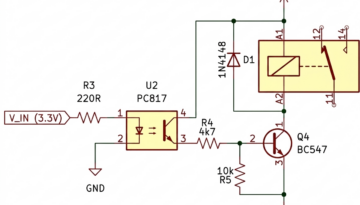
1. Introduction A schematic diagram is the universal language of electronics. It illustrates how components (resistors, capacitors, diodes, transistors, ICs, etc.) are interconnected to form a functional circuit. Learning to read schematics allows you to analyze, troubleshoot, and design electronic systems effectively. 2. Structure of a schematic Power sources: labeled as Vcc, Vdd, GND. Functional […]
1. Introduction Electrical power and efficiency are two key parameters that determine how effectively a circuit converts and uses energy. In real circuits, not all supplied energy reaches the load — part of it is inevitably lost as heat or electromagnetic interference (EMI). 2. Electrical Power Symbol: P Unit: Watt (W) Power represents the […]
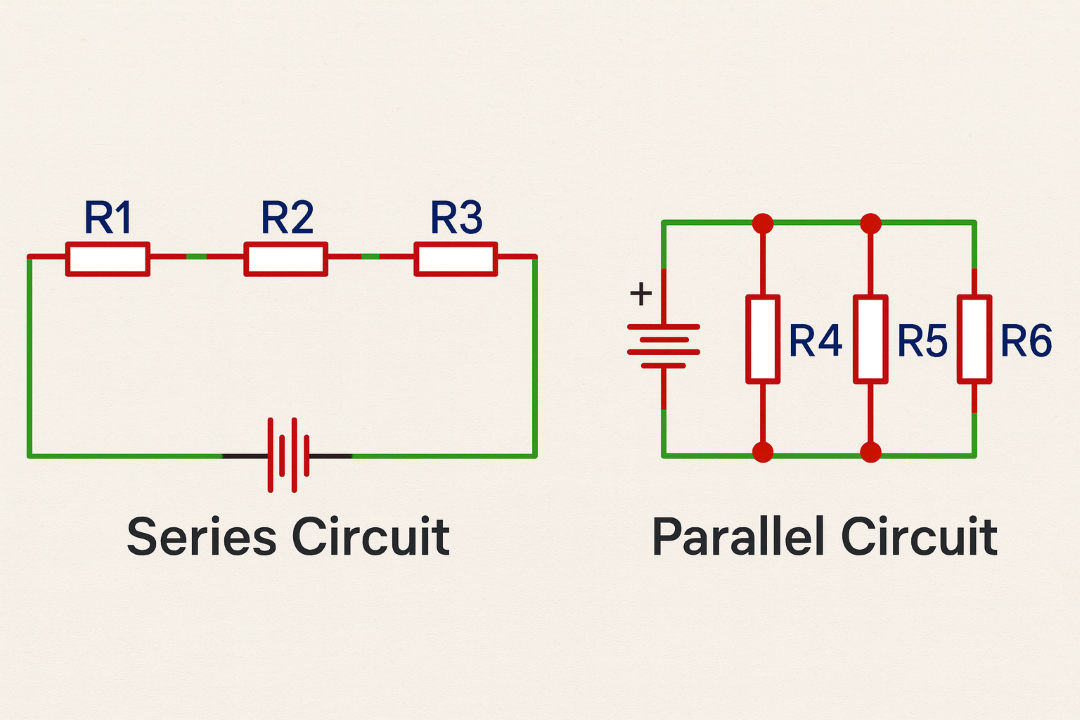
1. Introduction Electrical circuits are typically formed by combining components (resistors, capacitors, inductors, sources) in two fundamental topologies: series and parallel. Understanding the characteristics of each topology enables you to analyze circuits, compute equivalent resistance, voltage drops and current distribution — essential tasks for design and troubleshooting. 2. Series Circuits In a series circuit, components […]
1. Introduction Ohm’s Law describes the relationship between voltage (V), current (I), and resistance (R). It states that the current in a circuit is directly proportional to the applied voltage and inversely proportional to the resistance. This is the foundation of all circuit analysis. 2. Basic Formula The basic form of Ohm’s Law is: V […]
1. Introduction Electricity is the movement of charged particles—mainly electrons—through a conductor. It is the foundation of all electronic devices, from light bulbs and motors to computers and smartphones. To understand electronics, you must first grasp three key quantities: current, voltage, and power. These three are interrelated and describe how electrical energy is transferred, controlled, […]

Diodes are two-terminal semiconductor electronic components that allow current to flow in one direction while blocking it in the opposite direction. They play a vital role in various electronic applications, from rectifying alternating current (AC) to direct current (DC) to protecting electronic circuits from damage. 1. Structure and Operating Principle A diode is made of […]

Shunt resistors are electronic components that play a crucial role in current measurement, especially for high currents. They operate based on the principle of creating a low-resistance path parallel to the circuit, allowing for indirect current measurement by measuring the voltage drop across the resistor. 1. Operating Principle Shunt resistors are made from a low-resistivity […]

Pull-up resistors, also known as up-biasing or pulling resistors, are passive electronic components that play a crucial role in electronic circuits, particularly in digital circuits. This article delves into explaining the concept, functions, and applications of pull-up resistors to enhance your understanding of this essential component. 1. Concept of Pull-up Resistors: A pull-up resistor is […]